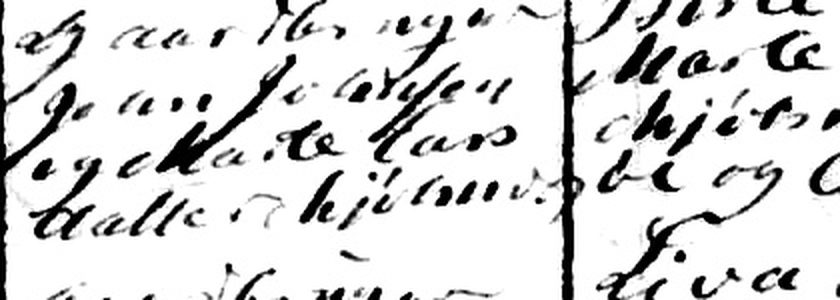
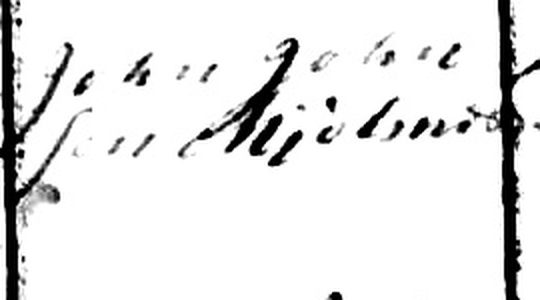
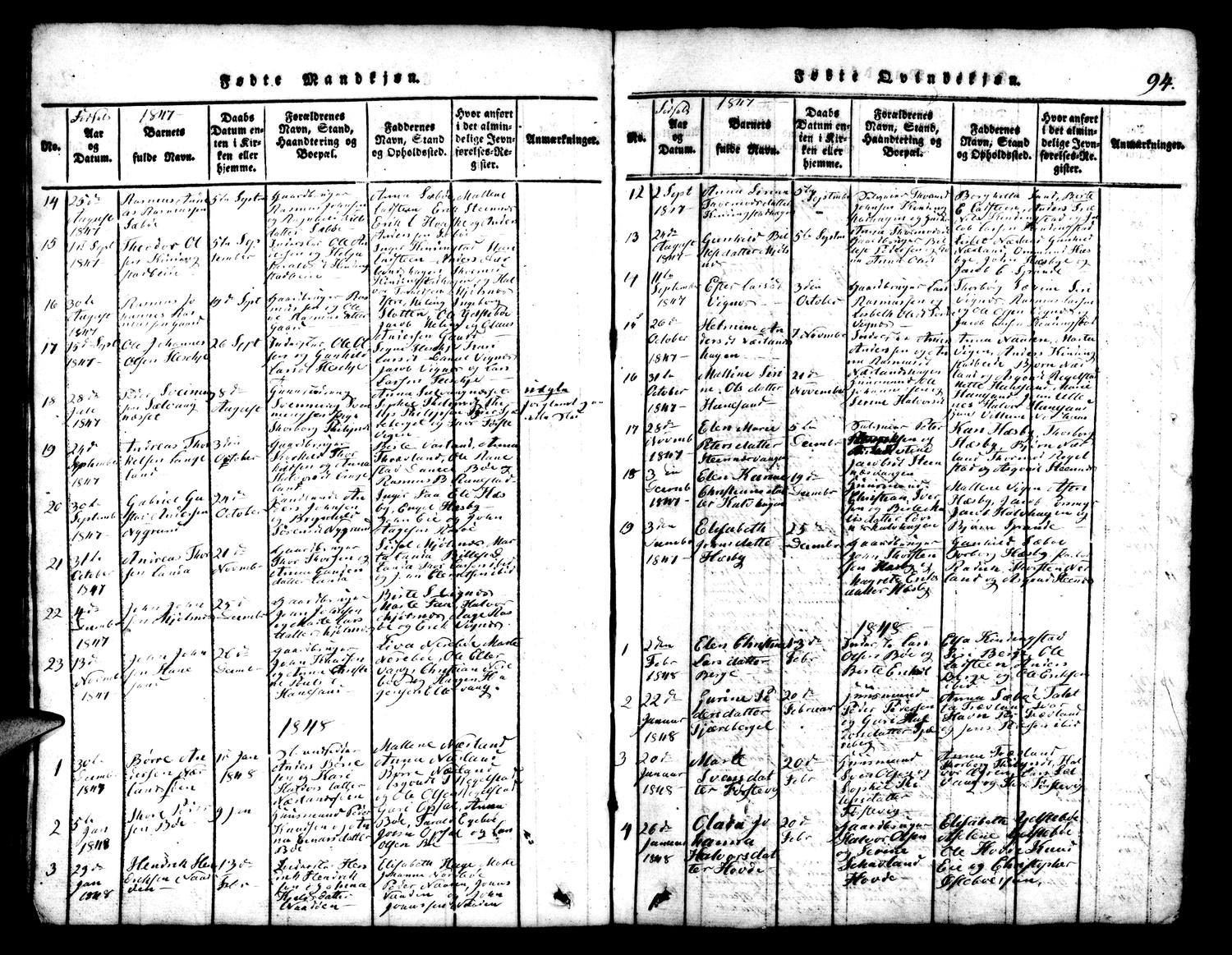
Finnøy parish register · births · 1847 · entry 22
For Barry and Lorna, and for Terry. Put together by Dean while the four of us were travelling through Norway, September 2026.
On the fourth of December 1847, on a farm called Mjølsnes on the island of Finnøy, a boy was born to a farmer named John Johnsen and his wife Marte Larsdatter. Three weeks later he was carried to church and baptised. The clerk wrote it down. That line is the oldest record we have of the family that became the Mjolsnesses of Sundre and Cochrane.
What it says, column by column
No. 22 · born 4 Decemb. 1847
John Johnsen Mjølsnes
baptised 25 Decemb.
Gaardbruger John Johnsen og Marte Larsdatter, Mjølsnes Gaardbruger means farmer, one who works a farm. The godparents' column names Berte S. Vignes, Halvor and Aage Vignes, and Erik Vignes, neighbours from the next farm along.
Why this line matters
The boy grew up to be John Johnson Mjolsness, who crossed the Atlantic, married Clara Rustad in the American Midwest, raised eleven children, and in his sixties moved the whole family north to Alberta. He is buried at Bergen, near Sundre. He is Barry's great-grandfather and Terry's great-great-grandfather.
Every generation between that line and today is on this page, and every fact carries a note on where it came from. Where we are only fairly sure, we say so.
Five generations
Read it top down. Each step is one generation.
Living family members are listed by name only. Dates for people who have died come from headstones and the family history; see How we know. The small ? marks point to open questions in the Casebook. The circles are placeholders for photographs: send one and it goes in.
Roughly 7,000 kilometres, four moves, sixty years
The exact year John left Norway is still unknown?. He is on the farm as a child, gone from Finnøy by the 1875 census, and a father in America by 1879.
Generation 5 · 1810s–1870s
Finnøy is an island in the Boknafjord, north of Stavanger on the west coast of Norway. In the 1800s most families there did not have a surname the way we think of one. A man was his father's son (John Johnsen, son of John) and he was known by the farm he lived on. When the family emigrated, the farm name is what stuck: Mjølsnes became Mjolsness.
The census of 1865 finds the household on the farm. The census taker wrote the name of the holding as Mjølsnæsbøen; ten years later the same family, on the same numbered property, is listed at Nedre‑Mjølsnæs, "Lower Mjølsnes".
| Name | Position | Age | Born |
|---|---|---|---|
| John Johnsen | Head of household, farmer, owns the land | 56 | Finnøy parish |
| Martha Larsdatter | His wife | 50 | Finnøy parish |
| Laurits Johnsen | Their son | 14 | Finnøy parish |
| Laugrentse Johnsdatter | Their daughter | 11 | Finnøy parish |
| Martha Johnsdatter | Lodger | 61 | Finnøy parish |
John, who would have been seventeen, is not at home that winter, and he does not appear anywhere else on Finnøy either. Young men from the islands went to sea or into service on other farms; where he was is one of the open questions?.
Generation 4 · 1870s–1910s
Somewhere between 1865 and the late 1870s John crossed the Atlantic?. We do not yet have the ship or the year: the Stavanger emigration registers for those decades were destroyed in a fire in 1929. What we do have is where he landed. He married Clara Jeanette Rustad, born in Wisconsin in 1862 to a couple who had themselves come from Norway. Her father, Andreas Anderson Rustad, was born at Hurdal, north of Oslo, in 1823, and is buried in the Immanuel Lutheran churchyard at Hendrum, Minnesota.
Hendrum sits in Norman County, in the flat, black‑soil Red River Valley near the North Dakota line. It was thickly Norwegian. The first child, John Alfred ("Jack"), was born in 1879; Alfred in 1887 is the first we can place at Hendrum for certain. By 1899 there were eleven.
Then the sons went north. Alberta was giving away quarter sections to anyone who would break the land. Martin and Jack filed on homesteads near Sundre in 1906, Joseph in 1909, and Louis in 1910. Their parents followed with the seven children still at home.
In Alberta John was more than a farmer. The Sundre museum's account of Minnie's life records that she and Louis "drove to Bergen to attend the Scandinavian Evangelical services conducted by Louis' father." John led the services himself.
John died at Bergen, southwest of Sundre, on 5 April 1916, aged 68. Clara died there in July 1923. Joseph, who had gone overseas with the Canadian Expeditionary Force, was killed shortly before the end of the war in 1918; he has no known grave and is named on the Vimy Memorial in France. Clarence had died at nineteen in 1908. Most of the rest of the family lie together in Bergen Cemetery.
Generation 3 · 1882–1958
Louis was the second son, born in Minnesota on 22 June 1882. He was twenty‑eight when he filed on his homestead near Sundre, and thirty when he made what the family history calls "a very important trip".
Minnie's own people came too. Her parents, Isaac and Caroline Granum, had farmed at Little Sauk in central Minnesota, where Isaac built the little country school Minnie taught in. They followed their daughter to Sundre. Isaac was killed in a farm accident there in October 1928, and Caroline, "Grandma Granum", moved in with Minnie and Louis and stayed for the rest of her life. The two families kept marrying each other: Louis's sister Lorenza married Minnie's brother Victor Granum in 1924, and Minnie's younger sister Cora married Hale Gochee, the mechanic who would later build Chester's first sawmill. Isaac, Caroline, Victor and Cora are all at Bergen Cemetery.
Four children were born on the small farm: Gladys, Lloyd, Chester and Marian. Louis farmed, logged his own timber, and spent three years sawmilling with J.T. Johanneson; he built a cabin at a spot seven miles west of Sundre called Sawdust Hill, and young Chester remembered helping him chink the logs with green moss.
In the fall of 1930 Louis went to a doctor for the first time in years, feeling poorly. It was liver cancer. He died fourteen days later at Didsbury, on 16 September, aged forty‑eight. Lloyd had turned fourteen nine days earlier; he quit school to run the farm.
Minnie died in May 1958. The family history says she "kept the family together" and that both Chester and, later, Barry credited their success to the foundation she laid.
Generations 2 and 1 · 1919 onward
Chester was eleven when his father died. He left school at fourteen with grade eight, "no honours" he admitted, allergic to grain dust and not cut out for the horses. So he found other ways to make money.
In 1938 he took his first sawmill job. In 1943 he bid on a timber berth southwest of Sundre and, not realising there was competition, ran the price to three dollars a thousand board feet, the highest anyone in Alberta had paid at the time. He had the timber and no mill. His uncle Hale Gochee, "a genius at mechanics", built one that winter out of scrap iron and old car parts in the blacksmith shop on the family farm, with the help of the only welder in Sundre. It started up on 1 March 1944 with five hundred dollars borrowed from Minnie.
Lloyd sold the farm and joined his brother; in 1947 they became equal partners as Mjolsness Brothers, later Spray Lake Sawmills. Through the 1950s and 60s they cut timber in the Spray Lakes country above Canmore, and every summer when school let out the workers' families moved up to the camp at Mud Lake. One year there were twenty‑seven children. Chester and Beryl's boys, Brian and Barry, grew up in those camps.
In 1968 the brothers bought sixty acres at Cochrane to bring everything under one roof. A Boxing Day fire destroyed the first mill there, uninsured. The new steel mill opened on 21 June 1974, and Spray Lake Sawmills became the town's largest employer. Chester and Lloyd retired in 1979–80 and handed the business to Brian, Barry and their brother‑in‑law Gill Ilk. By 1990 Barry owned it outright.
Barry married Lorna Jean Cavanaugh in August 1970. Lorna, "strictly a town girl" from Canmore, spent that first winter cooking at the Mud Lake camp in a fourteen‑by‑sixteen cabin with no water or plumbing. Their second daughter, Terry, was born in 1973 while the family's mobile home was being moved from Water Valley to Cochrane.
Beryl died in December 1996. Chester later married Martha, of Bottrel, who was with him at the end. He lived to see it all: eleven grandchildren, seventeen great‑grandchildren, two great‑great‑grandchildren. He died at home with family on 5 March 2021, at one hundred and one, and was buried at Bergen Cemetery six days later, beside Beryl and a few rows from his parents and grandparents.

If you are in Stavanger
Barry and Lorna, if you want to stand on it: Mjølsnes is still on the map. It is a small cluster of farms on Finnøy, which since 2020 has been part of Stavanger municipality. The island is reached by road tunnel; from the city centre it is roughly forty minutes' drive, and there is a summer fast boat as well.
Ask for Mjølsnes on Finnøy. The holding the family worked was listed as property no. 80 in the 1860s and 70s (Mjølsnæsbøen, then Nedre‑Mjølsnæs); farm numbers were reassigned later, so today's address may differ. The parish church where John was baptised on Christmas Day 1847 was the Finnøy church of the time; the godparents came from Vignes, the neighbouring farm, which is also still there.
There is a family memory that "they came from Hedalen, in Sør‑Valdres", a mountain valley in eastern Norway, hundreds of kilometres from Finnøy. The church book and two censuses put the Mjolsness line on Finnøy beyond reasonable doubt, so the Hedalen memory most likely belongs to another branch?, the Granums or Clara's Rustad family, whose father came from Hurdal, not far from Valdres. That is the next thing to test.
Another Mjolsness family from Norman County, Minnesota, the Christianson line, was born across the fjord at Nedstrand. Same farm name, same Minnesota township, a generation apart. Whether the two families were cousins is a question for the older church books?.
Every fact has a home
This page was built in one day in September 2026, working outward from a single local‑history article. Here is the trail, and the grade we give each source.
| Source | What it gave us | Grade |
|---|---|---|
| Finnøy klokkerbok 1816–1856, births 1847 no. 22 (Arkivverket, ref. SAST/A‑101825/H/Ha/Hab/L0001) | John's birth, baptism, parents, farm, godparents | Primary |
| 1865 census of Finnøy, farm 80 (Digitalarkivet source 38215) | Parents' household, siblings, ages, that John Sr. owned the land | Primary |
| 1875 census of Finnøy, Nedre‑Mjølsnæs (Digitalarkivet source 52256) | Parents still alive and farming; John gone | Primary |
| Finnøy church books 1773–1816 and 1816–1846 (sources 8813, 8814): marriages 1812 and 1846, baptisms 1812 and 1815 | Marte's marriage, baptism, parents and their marriage | Primary |
| 1801 census of Finnøy (source 58361), Østebøe and Søndre Vignes | Marte's grandparents; the Vignes households | Primary |
| 1701 male head‑count, Ryfylke (source 38452), Østebøe | Rasmus Jonsen and sons; generations 8–9 hypothesis | Primary |
| "Mjolsness Family", CHAPS Cochrane, from More Big Hill Country (2009) p. 606 | Generations 1–4, the stories | Secondary |
| Find a Grave memorials, Bergen Cemetery and Hendrum MN | Dates, burial places, family links, Clara's parents | Secondary |
| Alberta Ancestors (Alberta Genealogical Society), Bergen Cemetery index | Confirms Chester's burial | Secondary |
| Chester Jerome Mjolsness obituary, Cochrane Country Funeral Home (2021) | Chester's family in 2021, second marriage, burial | Secondary |
| "Minnie (Granum) Christensen", Central Alberta Museums / Sundre & District Museum, written by Edna Bakken from Chester, Gladys and Mary Mjolsness | Minnie's parents and birthplace, John as preacher, the 1902/1907 dates | Secondary |
| Family memory (Barry & Lorna, 2026) | "Hedalen, Sør‑Valdres" | Untested |
Generation 5 (John's parents) rests on a primary record we read ourselves plus two census matches. Generations 1 to 4 rest on secondary sources only so far; the next step is Alberta death registrations and the Canadian and U.S. censuses, which will either confirm them or correct them.
Generations 6 to 9 · Talgje island, 1654–1846
Neither John Johnsen nor Marte Larsdatter was born on the Mjølsnes farm. They married into it. Marte's side can be followed back another two generations with certainty, and two more with a good argument, all on one farm on the next island over.
On 4 November 1846 the Finnøy priest married John Johnsen, 35, of Mjølsnes and Marte Larsdatter, 31, of Søndre Vignes. Thirteen months later their son John was baptised, and the godparents who stood for him, the Vignes family, were Marte's people.
Marte herself was baptised on 5 March 1815, daughter of Lars and Berthe of Søndre Vignes. Lars was Lars Christophersen, a farmer's son from Østebøe on Talgje, the small island south of Finnøy; he had married Berthe Eriksdatter of Søndre Vignes on New Year's Day 1812, after banns read on the first of December. Their first child, Kari, came the next winter; Marte three years later.
The 1801 census, the first in Norway to name every person, finds Lars at twenty‑five still at home on Østebøe with his parents, Christopher Christophersen, 61, and Marthe Holgersdatter, 58, "both in their first marriage", and his sister Astri. Two other Christophersen households farmed the same land, one of them headed by a younger Christopher with a brother named Holger. Norwegians named children for their grandparents, and those two names, Christopher and Holger, are the parents' fathers coming back around.
A century earlier, in 1701, the Crown counted every male in the country for the army. On Østebøe it recorded Rasmus Jonsen, 47, with his sons Peder, 16, Christopher, 12, and Joen, 9. A Christopher born about 1689 on the farm where a Christopher Christophersen born about 1740 later farmed is the natural father. Nothing yet proves it: the parish's baptism registers before 1789 are not transcribed, and the church book that would cover the 1740s survives only as scans. So generations 8 and 9 are a strong argument, not a record. The Finnøy farm history, three volumes published in the 1990s, almost certainly settles it, and it is the next thing to read.
John Johnsen's own beginnings are the odd gap. He was born about 1810 on Talgje, but no Finnøy baptism of a Jon or John in those years is his, and none of the fathers named Jon, Jonas or Johannes had a son by that name. He may have been christened in a neighbouring parish. Until that is found, his line stops with him.
| Gen | Who | Where | Standing |
|---|---|---|---|
| 9 | Rasmus Jonsen, b. about 1654 | Østebøe, Talgje (1701 count) | Probable |
| 8 | Christopher Rasmussen, b. about 1689 | Østebøe, Talgje (1701 count, aged 12) | Probable |
| 7 | Christopher Christophersen (b. ~1740) & Marthe Holgersdatter (b. ~1743) | Østebøe, Talgje (1801 census) | Confirmed |
| 6 | Lars Christophersen (b. ~1776) & Berthe Eriksdatter | m. 1 Jan 1812; farmed Søndre Vignes, Finnøy | Confirmed |
| 5 | Marte Larsdatter, bapt. 5 Mar 1815, m. John Johnsen 4 Nov 1846 | Søndre Vignes → Mjølsnes | Confirmed |
On paper, no, and not for anyone. Norway's parish registers reach the 1600s; head‑counts and tax rolls reach the 1640s; before that the records for ordinary farmers simply stop. The only lines that run into the Viking Age are royal and noble ones through the sagas, and the connections from farming families into those lines are almost always wishful.
In every other sense, yes. The people counted on Østebøe in 1701 were farming an island in the Boknafjord, a few kilometres from Hafrsfjord, where Harald Fairhair united Norway in 872, and up the coast from the royal seat at Avaldsnes. Nobody moved much. The families farming those islands in 1654 were, overwhelmingly, descended from the families farming them in 954. The names are lost; the descent is not in doubt. A Y‑chromosome test on the unbroken male Mjolsness line would say which Norse paternal lineage it carries, which is the closest thing to a yes that exists.
Open questions
Every unknown, and everything already settled, lives in the Casebook. The five where family memory would help most: